Why Everyone Should Have a Personal Mission Statement
Everyone should have a personal mission statement. It’s one of the most powerful things you can do to shape your life, from what you do day-to-day to the person you become.

Personal productivity and growth insights for aspiring achievers — practical, actionable, and distilled from real experience.
You know the struggle.
I feel there’s so much more I could be doing. I look at other guys my age, and they have their act together so much more than me. They’re getting promoted at work, and I’m stuck where I am. They get up and hit the gym before work, and I barely make it to work on time. … I feel like I could do so much more if I could just get my act together!
My second biggest problem is the same as the first, basically. Not only are there not enough hours in the day, I want to fit more in. I already don’t have enough time to do everything I want, and I want to do more!
I don’t say no enough. There just isn’t enough time to get all the real work done in between the meetings and other time commitments.
We all want a better future. We want tomorrow to be better than today. But we’re still trying to catch up with yesterday. We never get a chance to get ahead.
Ask yourself:
If so, you’re not alone. We all feel this way. More often than we want to admit.
Technology was supposed to make our lives easier. The sad reality is we’re now busier than ever. We’re constantly connected. Anyone can grab our attention any time. We are exposed to more information in a day than our parents were exposed to in a year, and more than our grandparents were exposed to in their entire life.
We spend so much time running around putting out fires that we never stop to ask ourselves one important question:
Why are so many fires starting in the first place?
I don’t have all the answers. I’m no guru sitting on a mountaintop. I’m down in the thick of it every day, just like you are. I make mistakes. I have bills to pay, I get to bed later than I want, and I’m trying hard to be the man my kids think I am.
I don’t have all the answers, but I’m happy to share the ones I have. I’ve made enough mistakes (and watched others make more) that I’m starting to get an idea of what works and what doesn’t.
I’ve always been drawn to questions of structure and intention.
How do we stay on top of our responsibilities without feeling overwhelmed?
How do we do meaningful work without neglecting our families?
How do we build systems that support growth instead of just keeping us busy?
The problem isn’t a lack of ambition or motivation. We lack clarity.
We carry a lot — work, marriage, fatherhood, faith, leadership — and it’s easy to feel like you’re constantly behind in at least one of them. The pressure isn’t always loud, but it’s there.
Over time, I’ve learned that much of that weight comes from friction: unclear priorities, scattered commitments, and too many open loops competing for attention.
This site is my attempt to reduce that friction.
Here you’ll find practical systems for managing your day-to-day — but those systems are in service of something bigger. They’re meant to help you think clearly about your commitments, your work, your family, and your faith without feeling constantly behind.
Because the tools aren’t the point.
The point is living deliberately.
Leading your family well.
Doing meaningful work.
Becoming the kind of man you meant to be.
This isn’t hustle culture. It’s not optimization for its own sake.
It’s structure in service of growth.
New here? These are the best places to start — my top picks from each category.
Everyone should have a personal mission statement. It’s one of the most powerful things you can do to shape your life, from what you do day-to-day to the person you become.
Be true to yourself. It’s good for you, and for those around you.
My grandmother’s fine china taught me a lot about her priorities, and paying attention what means the most to me.
Sometimes the best thing you can do to increase your productivity is also the simplest.
Everything we do can be put into one of four quadrants on a grid, depending on its importance and urgency. Keeping this model in mind helps keep your attention on the most important things in your life.
Any space you leave open in your schedule will naturally and automatically fill with gravel. The key to being productive is to fill your bucket with big rocks before it fills up with gravel.
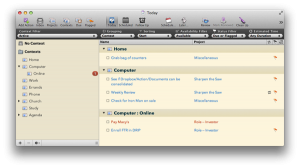
An OmniFocus perspective that will help you focus on the tasks you’ve selected to work on, without missing approaching deadlines.
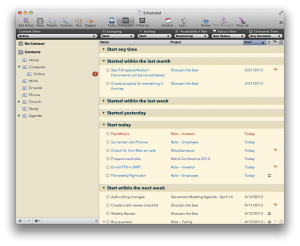
How to use the deferred date in OmniFocus to schedule tasks for a specific day, week, or month.
Using deferred dates is the best way to schedule a task for a later date. With a little bit of scripting, you can have them automatically show up in your list of what you’re going to do today.
Van Halen was famous for banning brown M&Ms from the dressing room. It wasn’t eccentric; it was a brilliant idea.
Email is an important part of how we communicate. Your signature is at the end of every message you send. Be sure it isn’t sending the wrong message about you.
Part of sharpening the saw is a willingness to experiment and tinker with how you do things, figuring out what works and what works better. We stopped using credit cards to see what happened.
Bite-sized, actionable info that you can directly apply while using OmniFocus. … You’ll also discover a slew of practical productivity tips and tricks for GTD.
Colter provides a great mix of powerful, yet simple how-to articles that will help you accomplish more and thought-provoking quotes you probably haven’t seen before.
A wealth of info and excellent writing has made this site a “must add” to my RSS feed.
You have one of the coolest first names, ever. You should be a superhero.
You really can spend your time the way you want to, focusing on the things that matter most to you. It takes courage, consistency, and clarity — but it can be done. Get the Daily Blueprint free when you join the list.